

Bleak Home
On the wisdom of "Bleak House"

A few weeks ago a friend asked me what I was reading to ward off the winter doldrums. Reader, I was forced to answer “Bleak House.”
Bleak House is indeed depressing. I know, shocker! Like all Dickens, though, it is extremely funny. It’s especially amusing to read as a former corporate lawyer - it skewers the stultifying minutiae of legal proceedings with Dicken’s typical wit.
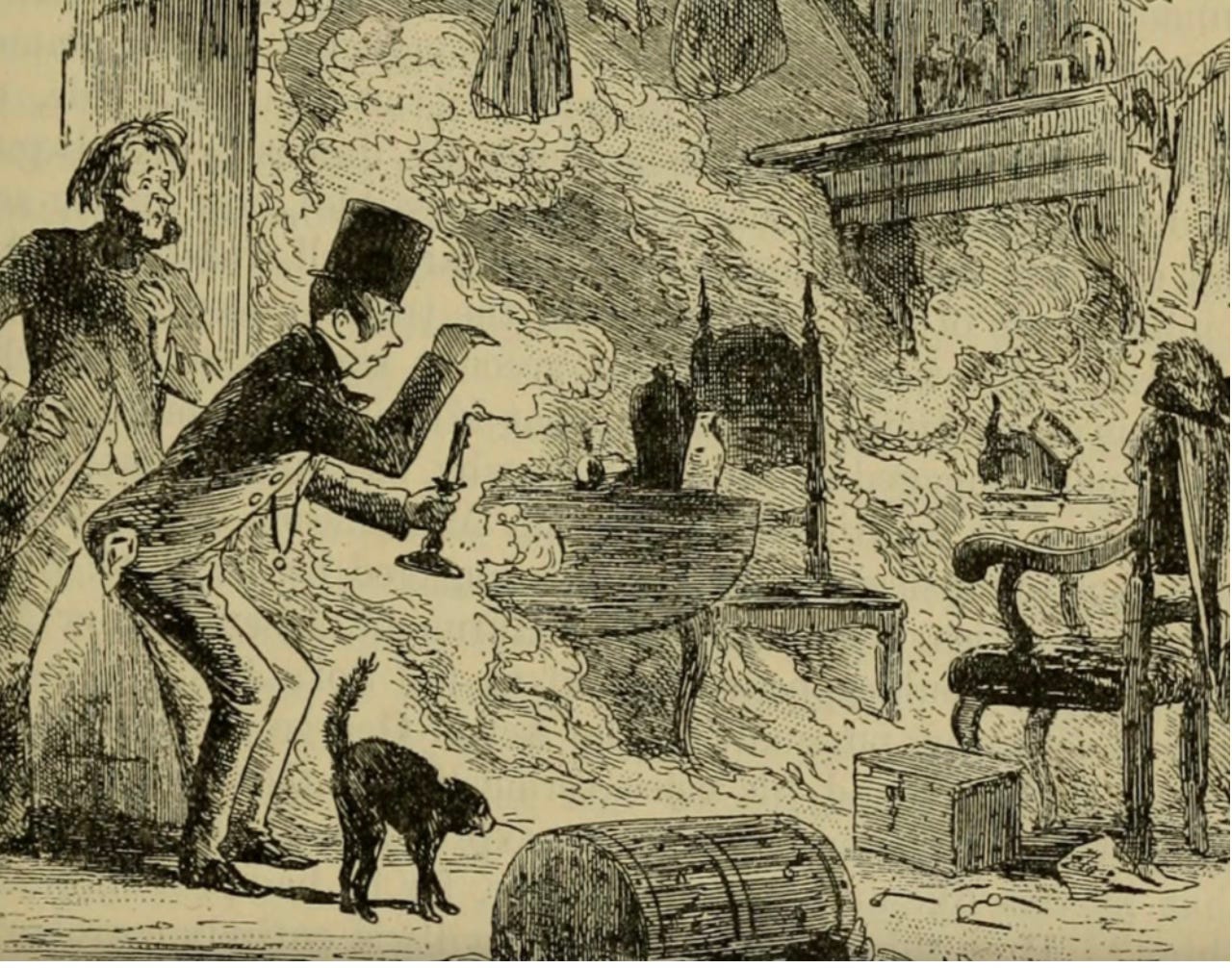
Bleak House is worth reading for the side characters alone - the kindly old woman with a flock of pet birds with names like “Spinach,” “Youth,” “Despair,” and “Sheepskin,” the smarmy rag dealer who spontaneously combusts to death, and Mrs. Jellyby, a self-righteous mother of many obsessed with “helping” the occupants of a far-off village called Borrioboola-Gha.
I’ll admit I find the protagonist of Bleak House, Esther Summerson, almost too perfect. She is almost a parody of gentleness and patience. No less than Charlotte Brontë called her “weak and twaddling,” so I guess I’m not alone!1
Despite her unrealistic levels of virtue, though, Esther is lovable. She’s raised by a hateful guardian and faces social rejection for her out-of-wedlock birth, but she is never bitter. She’s the opposite of a misanthrope, doting on the unfortunate Jellyby children and also her distant relatives. Esther embraces people and serves those around her however she can. Even after a terrible bout of illness ravages her body, Esther reflects upon “[h]ow little I had lost, when the wide world was so full of delight for me.”2
Like the other characters in Bleak House, Esther is snared in the tendrils of an endless probate litigation called Jardynce and Jardynce. Per Dickens, “Jarndyce and Jarndyce drones on. This scarecrow of a suit has, in course of time, become so complicated that no man alive knows what it means.”3 This may be familiar to anyone who has been to civil court, especially lawyers. Jardynce and Jardynce serves as a sometimes-comical indictment of the English legal system, but it is also a plot device that illuminates human tendencies towards despair and greed. Revisiting the passages about the suit, I’m surprised by how dark the context is:
Innumerable children have been born into the cause; innumerable young people have married into it; innumerable old people have died out of it. …[T]here are not three Jarndyces left upon the earth perhaps since old Tom Jarndyce in despair blew his brains out at a coffee-house in Chancery Lane; but Jarndyce and Jarndyce still drags its dreary length before the court, perennially hopeless.4
It’s both fascinating and tragic that Tom Jarndyce’s death devastates scores of people generations later.

Readers of Dickens won’t be surprised to hear that Bleak House features villains as wicked as Esther is wholesome, including the literally explosive Mr. Krook. (Dickens was apparently an ardent believer in the possibility of spontaneous human combustion, and felt personally insulted by people who dismissed it).5 There is also a literal murderer and an extortionist, and all of them are snared in the forever-expanding web of litigation related to Jardynce and Jardynce.
Also present are characters who are neither good nor evil, including well-meaning failures like Richard Carstone. Richard is a young and shiftless male that would fit perfectly into discourse about “lost” young men today. Richard, who like Esther is implicated via a distant relation in Jardynce and Jardynce, falls in love with a beautiful girl named Ada Clare but can’t bring himself to do right by her. He wants to find a career (allegedly), but doesn’t know what he wants to do and lacks the wherewithal to find out.
Rather than work seriously at something, Richard marries Ada in secret and focuses on obtaining a windfall via Jardynce and Jardynce. This fails when the suit finally settles, because the money Richard is owed goes entirely to litigation costs. In a very Dickensian twist, Richard dies penniless in the arms of his pregnant wife.
I think we’re all a bit like Richard. Many of us fail to take responsibility in day-to-day life, or appreciate our present circumstances, because we’re so fixated on something else. In some cases this may actually be due to an inheritance. A less literal reading works too, though. How many times have I neglected my responsibilities at home due to laziness, much like Richard? Richard’s guardian describes him as struggling to surmount an “incomprehensible heap of uncertainty and procrastination,”6 which has probably described all of us at one time or another.
Interestingly, the guardian wonders if the fact Richard was born during the legal tangle of Jardynce and Jardynce influenced his personality for the worse. I think Dickens was insinuating that the broken nature of the legal system seeped into the fabric of society and infected its inhabitants, which is an interesting point to consider about today’s shiftless young men. Even still, Richard remains responsible for his poor choices, which destroy more lives than his own.
Dickens creates a kind of parallel for Richard in the previously mentioned Mrs. Jellyby, who is so fixated on “charitable” deeds that she ignores her husband and children. Her house is filthy and her children are perpetually injured, which makes her philanthropic efforts seem rather pointless. After a visit to the Jellyby house, Esther surmises that “it is right to begin with the obligations of home…while those are overlooked and neglected, no other duties can possibly be substituted for them.”7
Mrs. Jellyby believes she has found her vocation, unlike the dilettante Richard. Still, these characters share a level of vanity that makes them neglect their basic responsibilities. This neglect alienates them from the people they love. Richard and Mrs. Jellyby show how a failure to prioritize can create a cascade of misery.
Then again, Esther is proof that it only takes one person to counter this tide with kindness.
For those of us from liturgical Christian traditions, it is currently the penitential season of Lent. Like many Christians, I long considered Lent a kind of forty-day punishment when I would continuously fall short of God’s expectations. Now I realize that Lent is an opportunity to consider first things.
Bleak House has led me to an examination of conscience of sorts. I can be like Richard and let worries, financial or otherwise, cloud my mind until I’m distracted from the beautiful life right in front of me. Similarly, I sometimes feel a Jellyby-like tendency to want to do something “big” for God when He is calling me to practical holiness, of patience and humility in the quotidian rhythms of life.
Esther may be a bit insipid, but she was certainly right - the obligations of our home come first. If love is our priority, all will be well.
The Dickens Project, “Even Supposing,” interview with Prof. Renée Fox, UC Santa Cruz (22 June 2020) https://dickens.ucsc.edu/even-supposing/.
Charles Dickens, Bleak House, Chapter XXXVI, (1993) Wordsworth Classics. Ware, England: Wordsworth Editions.
This is so absurdly real, even today. Id. Chapter I.
Id.
The Disappearing Spoon Podcast, “Hotter Than the Dickens,” Science History Institute Museum and Library, https://www.sciencehistory.org/stories/disappearing-pod/hotter-than-the-dickens/.
Bleak House, supra, at Chapter XIII.
Id. at Chapter VI.
One of my favorite Dickens! I want to finish the last 5 I have of his so I can rank them in good conscience.
Lovely reflection. I’ve been coming back again and again in prayer to “do what you are called to well and with love” before worrying about anything else. Turns out that’s harder than it seems! Definitely want to check out more Dickens after reading this