

Breaking Bread
On DoorDash and discomfort.

A recent New York Times piece describes the social consequences of DoorDash. For the uninitiated, DoorDash is a popular food delivery app that features the option of paying a premium for faster service.
The article opens with this telling question:
There’s pasta in the pantry and jarred sauce in the refrigerator. So what compels Kiely Reedy to keep having spaghetti with marinara delivered from the restaurant down the street, for several times the cost of cooking the dish herself?1
One interviewee “spends at least $200 to $300 a week on food delivery” and admits to social isolation. Another claims she “no longer feels the social pressure she once did to meet friends for dinner,” which is depressing. One picture featured in the article displays two women in their fifties sitting on a sofa waiting for a dinner delivery, looking away from each other, one scrolling absently on her phone.2
In a reaction to the New York Times piece, Gen Z reporter Sascha Seinfeld shared her own dependence on food delivery apps and observed: “Psychologically, even picking up food would beat delivery. It reminds you that you’re a living, mobile being, and briefly exposes you to potential human interaction and uncertain air temperatures.”3
These two articles encapsulate the fragmentation of our age. We are all (and I include myself in this description) enslaved by convenience. Most of us living in post-industrial society are detached the hands that prepare our food and the people who cultivate it, even those of us who rarely or never order food delivery.
But DoorDash has exacerbated this detachment by rendering everyone involved in the transaction anonymous, including the customer. Any need for face-to-face interaction is gone thanks to “no-contact” delivery. Under the DoorDash model, human contact is an anathema.
Reading all of this, I thought of James Herriot, the narrator of All Creatures Great and Small.
The All Creatures Great and Small series is a lightly fictionalized account of James Wight (who wrote under the pen name James Herriot)’s experiences as a country veterinarian in the Yorkshire Dales in the 1930s - 1950s. At that time, the Dales were very rural and mostly populated by farmers. Herriot, a Glasgow native, came to the Dales because their local veterinary office had an open position in the dismal economic conditions of the 1930s. He came to love the Dales so much that he spent the rest of his life there.4
Herriot’s time as a young vet abounds with hijinks, from runaway pigs to his first encounter with his intimidating future father-in-law to a haunting by the ghost of a medieval friar.5
Herriot frequently observes that the farmers of the Dales were very hospitable and had a robust local food culture. Given that Herriot worked long and physically demanding jobs for these farmers, he often shared meals with them. In the second installment of the series, All Things Bright and Beautiful, Herriot describes eating lunch with a local farmer and his wife after a successful calving.
Herriot relates for context that he had a “pathological loathing” of fat on his meat “which almost amounted to terror.” He nearly panics when the farmer’s wife serves him an enormous plate of boiled full-fat bacon, as he “could not possibly offend this sweet old person but on the other hand I knew beyond all doubt that there was no way I could eat what lay in front of me.”6
The flummoxed Herriot grabs a jar of piccalilli, a sort of assortment of homemade spices, and smothers the meat with it so he can bear the taste. He tells the tale with characteristic bravado:
Looking back, I realise it was one of the bravest things I have ever done. I stuck to my task unwaveringly, dipping again and again into the jar, keeping my mind a blank, refusing grimly to think of the horrible thing that was happening to me.
There was only one bad moment, when the piccalilli, which packed a tremendous punch and was never meant to be consumed in large mouthfuls, completely took my breath away and I went into a long coughing spasm. But at last I came to the end. A final heroic crunch and swallow, a long gulp at my tea and the plate was empty. The thing was accomplished.7
Herriot’s rendering might be dramatic, but it’s also fascinating. Breaking bread with others can be a wonderful experience, but it can be uncomfortable too. Again, this is why DoorDash is popular. It is easier - at least in the moment - to press a button and wait for our food to appear.
Clearly, DoorDash mitigates social pressure. Anyone who has attended a dinner party has felt some anxiety about how the conversation will go and picking up the wrong fork. If you are cooking for others, further potential pitfalls abound. Even cooking for one can evolve into cataclysm, as I have personally discovered.
DoorDash removes these concerns. Then again, it also deprives us of the joy of preparing a meal. That is no small loss.
Herriot may have felt miserable at that long-ago lunch, but he also recalled the incident decades later. It was part of the life he built in the Yorkshire Dales and his integration into a tight-knit community that he loved.
If DoorDash had existed when Herriot was a young vet, it’s likely that he would have never eaten with his clients at all. And it’s possible that if he had never broken bread with his neighbors, Herriot would not have felt like part of the community and would have eventually left the Dales for a higher-paying job.

For what it’s worth, I sympathize with people profiled in the Times article. When I worked as a corporate lawyer, sweetgreen delivery was an essential part of my life. I also ate many meals hunched over my computer, frantically pounding out emails between bites. During busy stretches, I was literally working so much that I didn’t have time to cook.
There really are some young professionals who can financially swing all of this delivery and may feel they have to for practical reasons. One of the Times’ frequent DoorDashers says he works so much that he throws money at the problem of making dinner.8 Some may scoff at this, but I know many people who do this. Many people in demanding jobs are so busy and burned out that “throwing money at the problem” is the only realistic option - but it’s not an easy way to live.
Cooking and sharing food with people we love is special. I appreciate it so much more now that I have the time to do it.
I love sitting down with my friends and our toddlers and trying to hold off the inevitable chaos. I love dropping off a meal for a friend. I love sharing food with my family and my friends and even enjoying it alone. Yes, cooking is time-consuming. Sharing a meal can be risky. It can even spiral into disaster, as it did for James Herriot eighty years ago. Moms of young children rarely sit through a full meal. Yet there is something so nourishing about sharing food together, something that transcends the ingredients on the table.
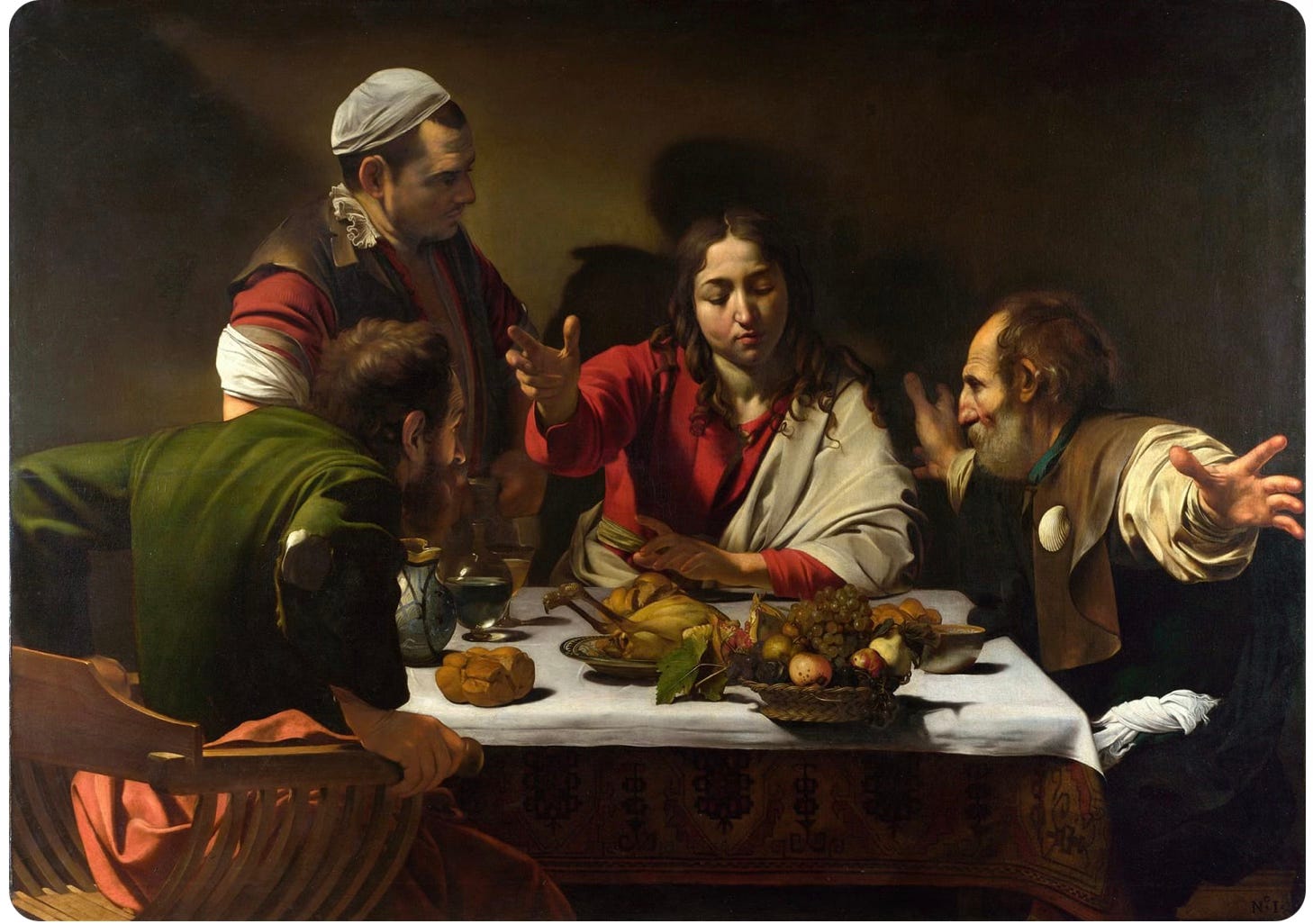
It’s no coincidence that the Last Supper is a centerpiece of the Gospel narrative. Jesus literally breaks bread with his apostles and institutes the Eucharist,9 which the Catechism of the Catholic Church identifies as “the source and summit of Christian life.”10 Jesus is the bread of life, and His bread gives us life.11 When I stop to contemplate all of this, I consider how sacred mealtimes can be if we approach them with love.
I think often of a young James Herriot at that farmer’s table. He knew exactly where that bacon had come from and who had prepared it. In fact, he had probably cared for the pig that produced it. Herriot was uncomfortable but managed to endure. One can imagine how connected Herriot must have to the Dales and its citizens, how caring for the farmer’s animals made him a crucial part of their community - and how much he cared about that farmer and his wife.
Not many of us can live like Herriot today. But praise be to God that we can all invite someone over for dinner.
This brings me to another point. Through Substack, I have encountered writers who care deeply about fellowship and food - Emily Stimpson Chapman, Grace Leuenberger, and Kate D. come to mind. Reading about their hospitality has encouraged me to make more meals for friends and host a few dinners. This is sometimes a frightening endeavor. No matter how scary hosting is, though, I find it comes together in the end. Hospitality matters, and imperfection is part of the deal.
Now that I’ve read about the prevalence of DoorDash, I will redouble my efforts. It might sound silly, but I hope to do a small part in combating the loneliness in the world.
Who knows, maybe one day I will be the subject of someone’s ridiculous dinner table story. It’s worth it if I bring people together.
Priya Krishna, “Freedom With a Side of Guilt: How Food Delivery Is Reshaping Mealtime,” The New York Times (30 January 2026), https://www.nytimes.com/2026/01/30/dining/food-delivery-apps-doordash-uber.html?unlocked_article_code=1.JVA.zs4k.wJ67hsimniJ2&smid=re-nytimes.
Id.

See generally James Herriot, All Creatures Great and Small, Griffin (2014); “James Herriot Biography”, The World of James Herriot, https://worldofjamesherriot.com/about-james-herriot/.
Spoiler alert: it’s not actually a ghost.
James Herriot, All Things Bright and Beautiful, Griffin (2014) Chapter 39.
Id.
See supra Priya Krishna, “Freedom With a Side of Guilt: How Food Delivery Is Reshaping Mealtime,” The New York Times.
Matthew 26:17 - 30 (NIV); Mark 14:12 - 26 (NIV); Luke 22:7 - 23 (NIV); John 13:1 - 30 (NIV)
(CCC 1324)
John 6:35, NIV
I love Herriot's stories but I haven't really seen the show, only a couple episodes here and there!
It's interesting that most of the people in these articles about food delivery are childless (usually once you have kids you can't afford $200-300 a week on doordash) ...I often miss how much more fun it was to eat at a restaurant before we had kids, when we do order food delivery it's because last time we went to the local Indian restaurant in person my son threw a full glass of ice water on the floor 🤣
Because we live up a long windy road, even then doordash delivery is rarely contactless - often the driver goes to a neighbor's and I have to chase them down. We do heavily rely on a lot of walmart same day delivery however... I don't know that we're missing out on much in the way of human connection at Walmart so I've never thought of it as any sort of loss 🤣
This piece has everything! Reflections on hospitality AND All Creatures Great and Small—my favorite :') Thanks for your tag here; hosting can be scary but sooo worth it. I have never once regretted hosting, nor the cost it comes with either literally or emotionally. Loneliness is only combatted through risk and sacrifice. Always worth it, IMO!