

Catholic Matriarchy?
On St. Hildegard of Bingen and beloved friends

I am also the fiery life of the essence of divinity; I flame above the beauty of the fields and I shine in the waters and I burn in the sun, the moon, and the stars. And with the airy wind I rouse to life all things with some invisible life, which sustains all things.
-Hildegard of Bingen on Divine Love1
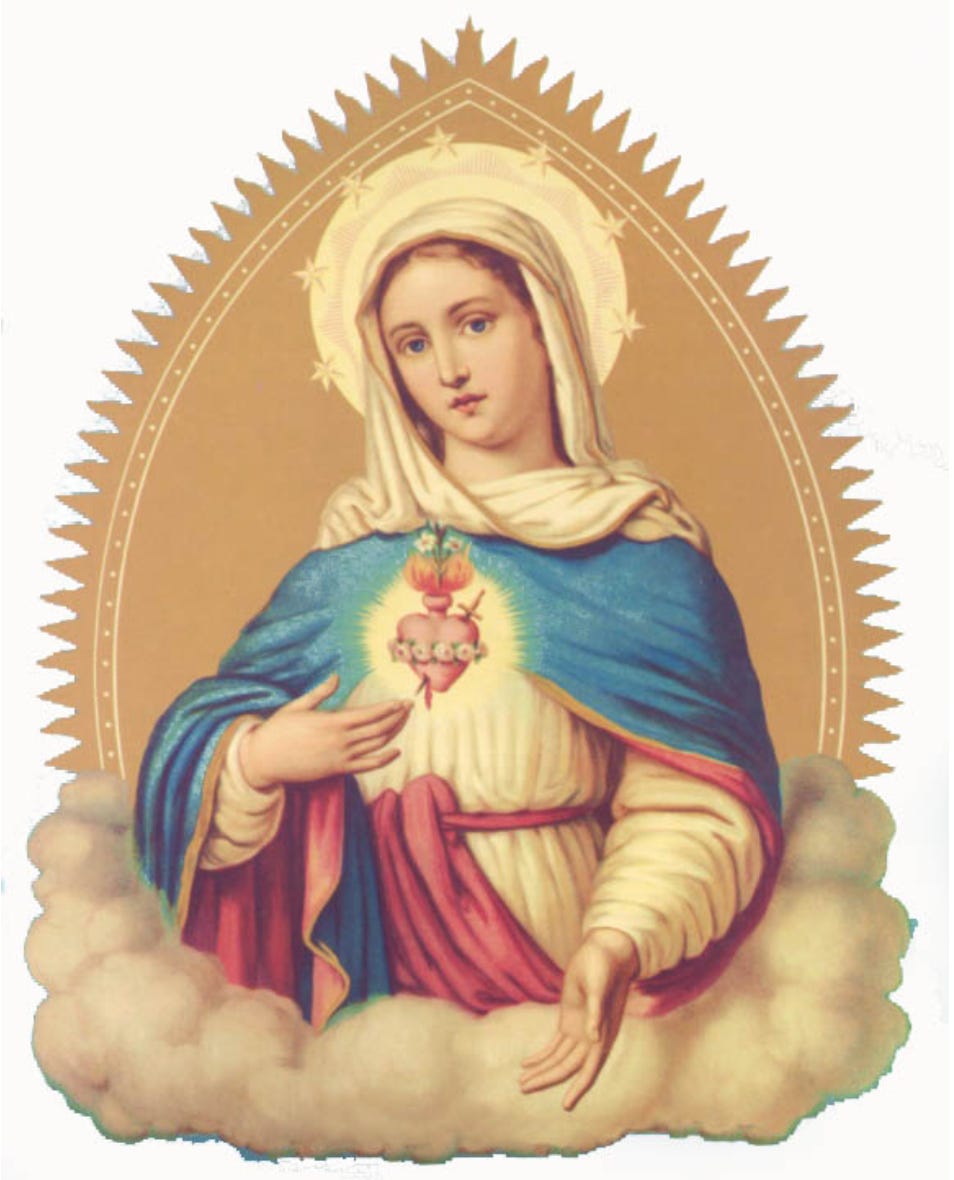
My younger sister informed me last week that women on social media claim to be “de-centering men.”
This seems related to the viral article “Is Having a Boyfriend Embarrassing Now?”, which I had the misfortune of reading for the first time this week. Apparently, influencers are now subtly telegraphing their relationship status rather than posting their boyfriends outright, because being in a relationship makes them “more beige and watered-down online.”2 I cannot bear to think any more about this horrifying sentence, so I’ll transition to my main point.
So much Gen-Z internet dialog circles ancient wisdom from traditional religious institutions, especially the sacramental worldviews of Catholicism and Orthodoxy. Do you know who really “de-centered” men? St. Lucy, St. Agnes, St. Cecilia, and St. Catherine of Alexandria, who chose torture and beheading over forced marriage.3
One of the best examples of a Catholic matriarch is St. Hildegard of Bingen, a twelfth-century nun who experienced vivid prophetic visions throughout her life. Hildegard was a genius, playwright, composer, writer, visual artist, theologian, and evangelist.4 She also wrote in detail about the menstrual cycle, childbirth, and the female orgasm, which she felt played a crucial role in human conception.5 Hildegard is now a Doctor of the Church, the highest honor that Catholicism confers. St. Teresa of Avila, another Doctor of the Church, was a Carmelite nun wrote profound musings on theology and prayer that are still widely read today.6
On a related note, the brilliant Spanish singer Rosalía recently released an album called “Lux.”7 Lux is largely a hagiography of female saints, and the lead single is both inspired by and a paean to Hildegard.
I think Lux is far superior to Sabrina Carpenter’s admittedly catchy and wildly popular “Man’s Best Friend” album. But I would wager that the average Gen-Z feminist is more familiar with Carpenter than Rosalía, even though Carpenter’s latest songs are almost entirely about her disappointing experiences with men.
Reflecting on Lux, Rosalía said in an interview recently:
“I’m tiring of seeing people referencing celebrities, and celebrities referencing other celebrities” […] “I’m really much more excited about saints.”8
Rosalía said this better than I ever could, so I will only reiterate how right she is. Self-absorbed people are boring, and almost all famous people, especially “content creators,” are pathologically self-absorbed. The saints are interesting because they love God first. We can all only hope to be like them.

Sometimes I think the Catholic Church is the most matriarchal institution in the modern world. Church history brims with fierce, brilliant women, and the Church honors them as saints, warriors, and theologians.
As I said, Hildegard is the epitome of this matriarchal nature. Hildegard wrote about the female body in an unprecedented way, and she was a fierce advocate for outspoken women:
“People are scandalized that in these days the Lord deigns to magnify His great mercy in the frail sex. But why doesn’t it cross their minds that a similar thing happened in the days of our fathers when, while men were given to indolence, holy women were filled with the Spirit of God so that they could prophesy, energetically govern the people of God, and even win glorious victories over Israel’s enemies? I speak of women like Hilda, Deborah, Judith, Jael, and the like.”9
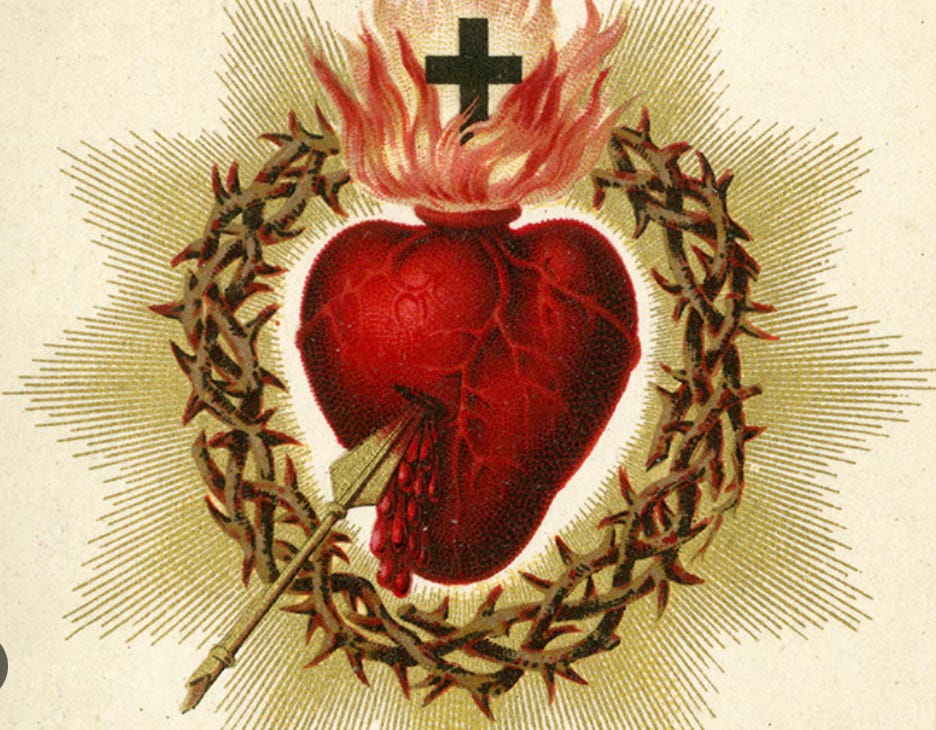
“For as the moon waxes and wanes, so for woman the blood and the humors are purged at the time of menstruation.”10
-Hildegard of Bingen on the menstrual cycle
Hildegard also wrote elaborate and insightful analogies between the flowering of nature and a woman’s body, recognizing that menstruation was a key sign of a woman’s health and fertility, one that could cease if a woman was poorly nourished or depressed.11 In one beautiful passage, she muses, “As a tree, from its greenness, brings forth blossoms and leaves and bears fruit, so too woman, from the greenness of rivulets of menstrual blood, brings forth blossoms and leaves from the fruit of her womb.”12
Hildegard’s canonization - and its promotion of her writings - demonstrates the Catholic Church’s reverence for the female body. So too does the Church’s famous Marian devotion. I could fill volumes about Mama Mary, but one of the most remarkable aspects of her story is that her decision to become the Mother of God was freely made.13 Mary chose to become the Theotokos of her own free will. If this doesn’t show how powerful young women are, I don’t know what does.
The Catholic Church’s reverence for the female body extends to Catholic marriage preparation classes, which require couples to learn about the rhythms of a woman’s menstrual cycle and how this relates to fertility. Boys in Catholic schools learn stories about Therese of Lisieux and Joan of Arc and revere them as heroes. I would guess that your average self-proclaimed “feminist” man could not name a female role model outside his own family. Meanwhile, a practicing Catholic man likely could not count his on one hand.
Reverence for women is everywhere in Catholicism, and Catholic women’s voices reverberate through millennia. Today, many of the foremost cultural voices defending Christian ethics are Catholic women. The inimitable Lila Rose recently joined Substack - she’s been doing undercover pro-life activism since she was a teenager, and her podcast is a beacon of Christian love in our fractured world. Helen Roy and Samantha N Stephenson explaining Catholic bioethics to the masses (i.e. me). Erika Bachiochi and Abigail Favale are modern Hildegards encapsulating Catholic theology from a female perspective, among other important work.
On a full circle note related to all of this, this week I inherited a Mom’s group at my parish. Let me explain.
In May 2024, I was an abjectly lost first-time Mom, desperate to leave my corporate job but terrified to do it because we could not afford it (or so I thought).14 I wandered into the Mom’s group at my local parish out of sheer desperation. Little did I know the women there would hold me up through a massive change as I shifted to being a stay-at-home Mom, that we would form a weekly Bible study together, and that they would hold me up in prayer through two miscarriages. This coming winter, I will become a Godmother to the new baby of one of these wonderful women.
The original leader of this group, now one of my best friends, has to move overseas for her husband’s job. I can’t help welling up when I think about how she welcomed me into her life and her home with open arms. I love her so much, and I can’t stop thinking about how much I will miss her. I can’t thank her enough for the gifts she gave me, but I can try to help others the way she helped me.
The matriarchy is out there for those who seek it. You only have to know where to look.
[1] Trans. by Nathaniel Campbell, from the Latin text of Hildegard of Bingen, Liber Divinorum Operum, ed. A. Derolez and P. Dronke, in CCCM 92 (Turnhout: Brepols, 1996), pp. 47-9.
Chanté Joseph, “Is Having a Boyfriend Embarrassing Now?” Vogue (29 October 2025), https://www.vogue.com/article/is-having-a-boyfriend-embarrassing-now.
“Saint Lucy,” Catholic Online, https://www.catholic.org/saints/saint.php? “Saint Agnes,” Catholic Online, saint_id=75; https://www.catholic.org/saints/saint.php?saint_id=106; “Saint Cecilia,” Catholic Online, https://www.catholic.org/saints/saint.php?saint_id=34; “Saint Catherine of Alexandria,” https://www.catholic.org/saints/saint.php?saint_id=341.
Britannica Editors. “St. Hildegard.” Encyclopedia Britannica, September 13, 2025. https://www.britannica.com/biography/Saint-Hildegard.
Hildegard of Bingen on Natural Philosophy and Medicine, Selections from “Causes et Curae,” ed. Jane Chance, The Library of Medieval Women, https://www.sweetstudy.com/sites/default/files/qx/17/06/07/10/hildegard2concausesandcures.pdf (see para. 78b).
See generally St. Teresa of Avila, The Interior Castle, trans. Rev John Dalton, (published 1852), https://www.carmelitemonks.org/Vocation/StTeresa-TheInteriorCastle.pdf.
Laura Snapes, “‘It’s impossible not to have contradictions in a contradictory world’: Catalan pop visionary Rosalía on critics, crisis and being ‘hot for God’,” The Guardian, (7 Nov. 2025), https://www.theguardian.com/music/ng-interactive/2025/nov/07/rosalia-critics-crisis-being-hot-for-god-lux-catalan.
Hildegard of Bingen on Natural Philosophy and Medicine, Selections from “Causes et Curae,” ed. Jane Chance, The Library of Medieval Women, https://www.sweetstudy.com/sites/default/files/qx/17/06/07/10/hildegard2concausesandcures.pdf (see para. 77a).
Id. at 77b.
Id. at 80b.
Id. at 79b.
“Behold, I am the handmaid of the Lord; let it be to me according to your word.” And the angel departed from her” ( Luke 1:38, RSV-CE).
Jesus looked at them and said, “With man this is impossible, but with God all things are possible.” (Matthew 19:26, NIV).
I really enjoy when the more acerbic aspect of your personality comes out in your writing; The dig at "feminist" men make me snigger. If I had to guess the women they'd claim to admire would either be a famous careerist type or, even worse, a woman in the sex industry, and that's even if they could name one at all.
I think the "de-centering men" narrative being pushed by the media is just another way to stoke up disdain between men and women, and is utterly ridiculous when thought about to any great degree. I would argue most women passed a certain age don't orient their lives around men, especially if they're happily married. If anything I would argue the lack of regard men and women often have for each other and the subsequent decline in marriage and childbearing is a greater problem than an individual woman being too obsessed with men, a mindset nearly all insecure teenage girls grow out of. If anything modern left wing thought demands that women center men (trans, sex work is work, etc.) in a way no previous ideology ever has in order to be seen as a good woman, which I would argue is predatory towards women's social nature and female socialisation, which often demands we smother our true feelings so as to not offend others.
So as to not write an entire novel in your comments, I'll conclude by saying I really enjoyed this piece. I'm Orthodox and have been particularly drawn to St Xenia of St Petersburg since the start of my religious journey. As you point out so many of the most interesting women to have lived are religious figures, and given modern liberalism's hostility towards faith their achievements are rarely counted.
You have such a gift for explaining and defending ideas with both eloquence and fearlessness! I’ll be pointing to your essays any time these topics come up in conversation, like, “This is the same thing I’m saying, but she says it better.” 😂