

On Staying
And the hero's journey.

I never wanted to stay in the place where I was born.
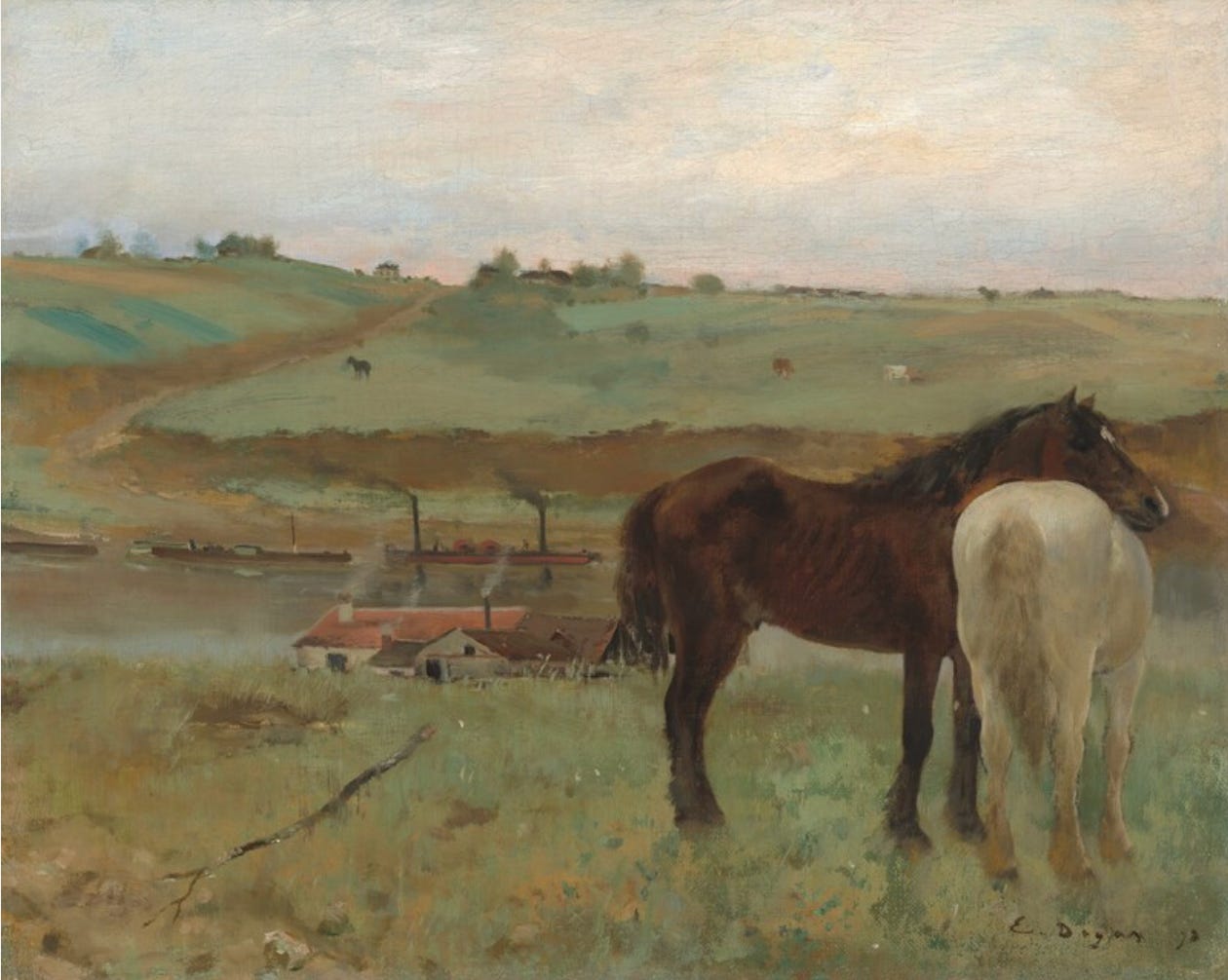
Not long ago I went to a museum in Baltimore with a friend and was startled to find a painting of my hometown, a small Northern New England city, in a gallery. There are pockets of beauty everywhere, but I never considered it a beautiful place. I remember stretches of brick as far as I could see, repurposed textile mills where my great-great-grandmother once made a living, the now-shuttered boarding school my grandmother attended on scholarship.
The painting depicted one of those textile mills, empty of their looms and hunched young women, converted into restaurants and rock climbing gyms.
For most months of my childhood, the trees stood stripped bare by frigid wind. Starless skies glowered overhead in the winter, and the world still shimmered because of the ice on the ground. If you stood over it just right it sometimes looked like water in the darkness, pitch black and fathoms deep.
There were old buildings with copper washed green by rain and schools built from faded sand-colored bricks, which themselves were mazes of leaking pipes and hand-painted murals. It was the wilderness further North that I found beautiful, or the seacoast to the East. The city itself felt too narrow, its streets too steep. The rivers were brown and green. I wanted to live where the skies were always blue and there were flowers on the trees.

What do we make of those who leave? I remember reading in tenth grade that leaving was an essential part of the hero’s journey. Odysseus left, and Ishmael, and Gilgamesh. Lewis and Clark pressed forward. What else was I supposed to do?
I do live far from home now. In a way, leaving home is to wander forever, though to varying degrees. Sometimes it is better to leave a place. My starving ancestors left Ireland. My Polish relatives fled the war, and Communism. My journey is not even comparable to theirs. Still, leaving feels like leaving. I am distant now.
I think not so much of Odysseus these days but of Ántonia - that is, of My Ántonia, the woman who stayed on the prairie and bore eleven children while her peers from the frontier moved to the city to make something of themselves. Is Ántonia a failure for living a simple life? For not making a name for herself in dressmaking as her childhood best friend did? I can’t say that she was.
There is something deeply human about remaining close to a place. We feel ties to the land and we want to know it. No doubt this is what inspires the twin revulsion and fascination with the “tradwives” of Instagram, and the farmers with their eggs like pale jewels. People like me, the cerebral class, have both heard and believed that there is one way to succeed. We do not forge a path from a place with our bodies but with our minds, and it is with our minds that we live, often in cubicles and behind screens.
It is frightening when something reminds us that we are more than a brain, that we are partly untamed. And that we are so separated from what sustains us - the soil that makes our food, the hands that package our bread. Not all of us can be farmers. But then, nearly all of us could be gardeners.
When Ántonia’s childhood friend Jim Burden visits her in Nebraska after several years, he is a successful lawyer. Ántonia is a hard-working woman who has lost many of her teeth by this point, though she is at most middle-aged. Still, there is something about her, he says:
I know so many women who have kept all the things that she had lost, but whose inner glow has faded. Whatever else was gone, Ántonia had not lost the fire of life.1
Say what you will about the woman who cannot and does not leave home, who lives a life we are told to consider small. There is something honest about staying close to a place and coming to know it.
I am incredibly grateful for my life and hold no illusions about Ántonia’s. She was a woman who worked harder than I could imagine, much like my great-great-grandmother in those textile mills.
Happy as I am, though, Ántonia remembered something I didn’t. Odysseus and Gilgamesh, even Lewis and Clark - all of them returned.
Willa Cather, My Ántonia, Project Gutenberg eBook (April 1995), https://www.gutenberg.org/files/242/242-h/242-h.htm, Book V, Chapter II.
Well this was a lovely thing to read first thing in the morning!
This is a topic I actually think about a lot, probably because most of my closest friends and family members have left, while I am one who stayed and I admittedly feel myself feeling sorry for myself due to their departures sometimes. My best friend growing up had immigrated to America from Taiwan and always said she couldn’t wait to get out of St. Louis, go to bigger cities and travel the world—which she did! She has lived in Europe and China and traveled all over, and lives across the world now. Where though? Taiwan. Even she returned.
I share this just because our teenage conversations really imbued in me the idea that staying in Missouri was loser behavior and it took me awhile to shake that idea, especially as my sister moved to Oregon, my closest cousin moved to Austin, and my other closest female friend backpacked across Europe and moved to D.C. But despite that idea being in the forefront of my mind, I never really wanted to leave.
I only ever wanted to live in a more rural area, so I moved a hour away from my historic river hometown (ironically, the town Louis and Clark began their journey from, St. Charles, MO) next to another historic river town on the same river. So I guess I did leave but not in a way that feels significant or drastic, just within reach of where I grew up but with more cows 😆
Anyway, I really enjoyed this and loved the My Antonia reference, as I am currently reading that book for the first time.
What a lovely reflection. Willa Cather is fantastic. I, also, growing up very much focused on the “going somewhere else=success.” But turns out the beauty of New England (we were lucky enough to live in a quaint town) kept tugging on my heart. And then I had my first son halfway across the country from parents/in-laws and realized there’s a real good to being near home and family. God be praised we got to move back, and am now trying to do some homesteady things I would never have pictured myself doing when I was focused on a worldly vision of intellectual “success.” Finally, I think this GK Chesterton quote is very apropos to this piece: “There are two ways of getting home; and one of them is to stay there. The other is to walk round the whole world till we come back to the same place: “